

Hotel Bathroom Privacy: What the Backlash Means for Glazing Design
Hotel Bathroom Privacy: What the Backlash Means for Glazing Design
Guest complaints are challenging assumptions about openness, screening, and personal space in hospitality.
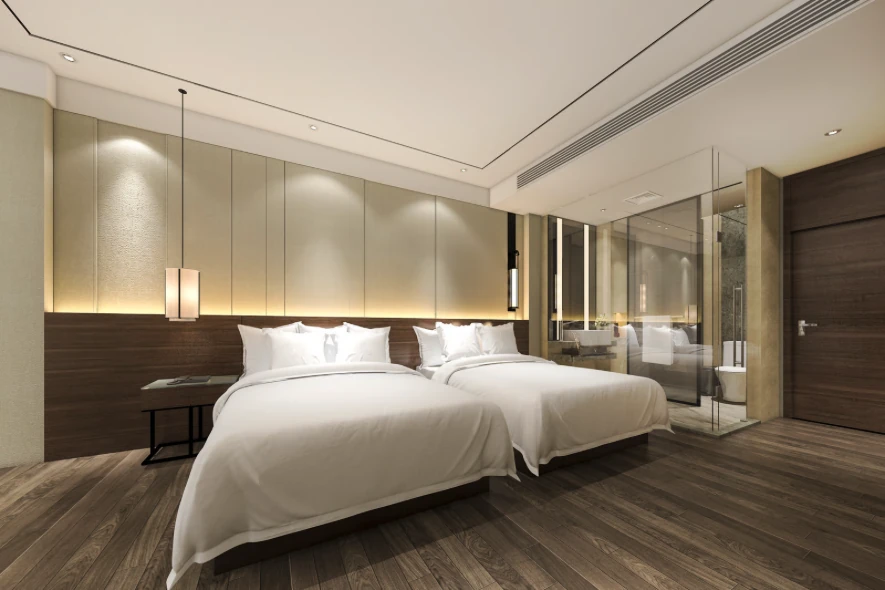
Two beds suggest a hotel room can accommodate two travelers. They say little about how comfortable those travelers will be seeing each other through a bathroom wall. That disconnect sits at the center of the backlash against open hotel bathrooms, where glass partitions and partial enclosures can create an appealing sense of space while leaving guests uncertain about their privacy.
For architects and hospitality designers, the debate raises a question about how design intentions translate into everyday use. Visual openness may contribute to a room’s character, but its success also depends on whether guests can comfortably share the space.
A door represents more than visual privacy
Traveler Sadie Lowell launched Bring Back Doors after sharing a twin-bed hotel room with her father and discovering that the bathroom had no door. Her website catalogs bathroom arrangements, including missing doors, transparent enclosures, and doors that screen views but provide limited separation from sound and odor.
CNN’s February 2026 coverage described frustrations with partially frosted panels, gaps around sliding doors, and bathroom blinds operated from the bedroom. HBA hospitality designer Paula O’Callaghan also emphasized enclosing toilet areas, including within more open layouts. A firsthand account from InsideHook’s travel editor described similar discomfort with frosted and translucent bathroom panels while traveling with her fiancé.
Hotel bathroom privacy involves several connected requirements:
- Visual screening: How effectively the enclosure conceals occupants and activities.
- Acoustic separation: How sound travels through doors, gaps, and surrounding construction.
- Ventilation: How the bathroom manages moisture and odors.
- Occupant control: Whether the person using the bathroom can establish and maintain privacy.
Glazing contributes to visual screening within that broader enclosure strategy. Understanding which concern a design needs to address helps determine whether changing the glass will resolve it.
Openness has to accommodate the people sharing the room
A glazed connection between the bathroom and bedroom can make a compact layout feel more expansive. Where an interior bathroom borrows light through the partition, glass also contributes to the lighting strategy. These qualities can be valuable when the design has limited access to exterior windows or needs to connect adjoining spaces.
The difficulty arises when the layout assumes a degree of intimacy its occupants may not share. Friends splitting a room, colleagues traveling for work, and parents accompanying adult children can have different expectations from those suggested by an open bathroom concept. Preferences also vary within close relationships, so room design has to accommodate more than one imagined type of guest.
Zoning allows those needs to be considered without applying the same transparency throughout the bathroom. An open vanity may have a different relationship with the bedroom from a bathing area or toilet enclosure. Thoughtfully selected hospitality privacy glazing can preserve selected connections, while other parts of the layout provide more consistent separation. The design question becomes where openness contributes to the experience and where concealment needs to be dependable.
How much privacy does obscured glass provide?
The term “privacy glass” can suggest a level of concealment that needs closer examination in a bathroom application. A panel may blur fine detail while leaving a silhouette visible, with the result influenced by lighting, viewing angle, and how close someone stands to the glass. Decorative bands and clear borders introduce further considerations when the view comes from a bed, chair, or room entrance.
For the occupant, these distinctions determine whether the space feels private. Knowing that another guest cannot see facial details may offer little reassurance if body shape and movement remain apparent. A meaningful assessment therefore considers the complete opening under conditions representative of the finished room. The appearance of an isolated sample provides only part of the information needed.
Fixed obscuring or decorative glass can provide consistent screening where a clear view serves little purpose. Integrated blinds and switchable privacy glazing offer adjustment where both visual connection and screening are appropriate. Each approach needs to deliver the required concealment in its intended location, with attention to coverage, light transmission, and the surrounding enclosure.
Adjustable privacy depends on control
The benefit of adjustable screening depends partly on who can operate it. A blind controlled from the bedroom gives the person outside influence over someone else’s exposure. Controls on both sides can create similar uncertainty if either user can restore visibility while the bathroom is occupied. These arrangements affect the privacy experience as directly as the glass itself.
Control placement and operating behavior should give the bathroom occupant confidence that their selected screening will remain in place during use. For electrically operated systems, the specified power-loss state also needs to suit the application. Ease of use belongs in the same discussion, since guests encounter unfamiliar rooms while tired, distracted, or preparing for an early departure.
These considerations bring the discussion back to the relationship between glazing and the complete room. Walls, doors, perimeter details, and ventilation provide the broader enclosure strategy. Within it, glass can transmit light, carry a decorative treatment, or introduce an adjustable visual connection. Its role is most effective when the intended privacy, operating conditions, and occupant expectations are understood together.
The backlash against open hotel bathrooms gives the industry a reason to examine those expectations more closely. A properly enclosed bathroom with an appropriate door may be the right response. Where glazing forms part of the design, its screening performance and operation should support the same comfort guests expect when they close that door.