

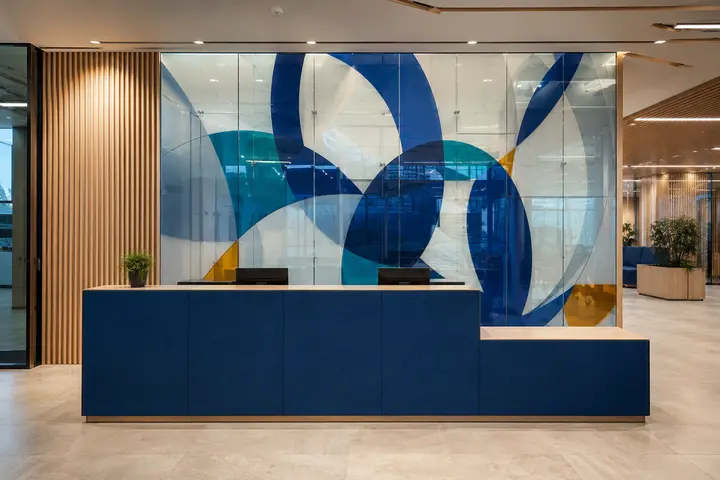
When Decorative Glass Becomes Spatial Strategy
How glass can shape privacy, communication, identity and the human experience of a space
A pattern on glass is never experienced as a pattern alone. It affects what people can see, how daylight moves through the room, where attention is directed, and how the space communicates.
Consider a gradient that obscures a direct sightline without making the entire partition opaque. In another setting, artwork might connect a building to its community, or a series of graphics could help visitors find their way through an unfamiliar space. Even a pattern developed for a façade may serve two purposes by contributing to the architectural expression and supporting bird-friendly design goals.
Although we call these treatments decorative, their influence extends well beyond appearance. Patterns, gradients, color, and imagery can all contribute to how a space functions and how people experience it.
Privacy does not have to be all or nothing
Privacy is often approached as a choice between clear and opaque glass, but many spaces need something in between.
A healthcare partition, for example, might use greater coverage at seated eye level and transition to more transparency above. The treatment limits direct views where privacy matters, yet daylight can continue to move between spaces. In an office, a different pattern might distinguish collaborative areas from private ones without creating a row of visually closed rooms.
The experience depends on more than the amount of ink placed on the glass. Pattern scale, spacing, density, and location all affect what remains visible and from which direction. A gradient can shift gradually between higher and lower coverage, while selected areas may remain clear to preserve orientation, borrowed light, or a connection to the surrounding environment.
Viewing distance also matters. A pattern that appears dense from across a corridor may feel more open when seen up close. Seated and standing sightlines can produce different levels of privacy as well.
Terms such as opacity, pattern density, and ink coverage describe these technical characteristics. For the person using the room, those choices determine whether the space feels exposed, protected, connected, or isolated.
Glass can communicate without becoming signage
Glass occupies a significant amount of visual space in many modern buildings, creating an opportunity to communicate without adding another sign, panel, or surface material.
Printed graphics can support room identification and wayfinding, while color and imagery can establish a recognizable identity across different areas of a building. A school may incorporate student artwork or references to its community. A healthcare facility might use familiar natural imagery to make an institutional environment feel less anonymous. In a workplace, visual motifs can reinforce the organization’s identity without placing a logo on every available surface.
Decorative glass can also strengthen the connection between a building and the place it serves. Local history, cultural references, archival photographs, and commissioned artwork can become part of the architecture rather than additions placed into the space afterward.
The glass still performs its basic role as a door, wall, partition, or façade. At the same time, it can help people understand where they are, what the place represents, and how they should move through it.
The experience is larger than the artwork
Selecting or creating the image is only one part of the process. Designers also need to consider how people will encounter it in the finished space.
A composition that looks balanced on a computer screen may feel entirely different when enlarged across several floor-to-ceiling lites. Fine details that are visible from a few feet away may disappear across an atrium, while a dense pattern could feel heavier at full scale than expected. Lighting, reflections, surrounding materials, and the view from each side will influence the result.
Movement changes the experience, too. Someone may first see the glass from a distance and then pass alongside it as the printed design, reflections, and surrounding architecture overlap. A treatment that appears relatively solid from one angle may become more transparent from another, especially as daylight and interior lighting change.
None of this limits the creative possibilities. It simply helps ensure that the artwork works at the scale of the building and produces the intended effect once it leaves the screen.
The strongest decorative-glass concepts account for both views: the image placed on the glass and the experience created within the space.
One surface can answer more than one need
Some of the most thoughtful applications of decorative glass are difficult to place into a single category.
A patterned partition may provide privacy and reinforce identity. Environmental graphics can support both storytelling and navigation. A façade pattern may add visual character while also helping make the glass more visible to birds when its dimensions, spacing, and placement follow the appropriate criteria. A gradient can interrupt direct sightlines without sacrificing daylight or the sense of connection that made glass desirable in the first place.
Of course, adding a pattern does not automatically produce every potential benefit. The outcome still depends on viewing distance, design scale, spacing, placement, color, glass composition, lighting conditions, and applicable performance requirements.
However, recognizing that one surface may serve several purposes changes the design conversation. Privacy, communication, identity, and visual interest do not always need to be treated as separate additions. A coordinated glass treatment may address several of them while reducing the number of competing elements in the space.
How digital ceramic printing expands the possibilities
Digital ceramic printing uses digital artwork and ceramic inks to reproduce custom patterns, gradients, colors, detailed graphics, and photographic imagery directly on architectural glass.
Once printed, the glass is heat-treated. During tempering, the ceramic ink fuses permanently to the surface, creating a durable architectural finish.
The process is technical, but its value to architects and designers is practical. Artwork can be developed around the dimensions of a specific project instead of being selected from a limited library of standard patterns. Coverage may vary across an individual lite, and larger compositions can continue across multiple panels. Color, imagery, and transparency can respond to the architecture and the intended experience.
Technical decisions ultimately shape what people see and feel. Ink coverage influences visibility, resolution determines how much detail can be reproduced, and pattern scale affects perception at different distances. Color may also shift as it interacts with daylight, glass composition, interior lighting, and nearby materials.
Understanding these relationships helps preserve the creative intent while ensuring the finished glass performs as expected.
Asking more of the glass
Decorative glass may be defined by what appears on its surface, but its greater value comes from what that surface helps the space accomplish.
It can manage visibility without eliminating connection, communicate without adding another material, and give a building an identity rooted in its purpose or place. In many cases, one carefully developed treatment can contribute to several of those goals at once.
Through DecoGlass, PGS helps project teams translate patterns, gradients, custom colors, detailed graphics, and photographic imagery into durable architectural glass. The opportunity is not simply to make glass more decorative, but to use it more intentionally.