

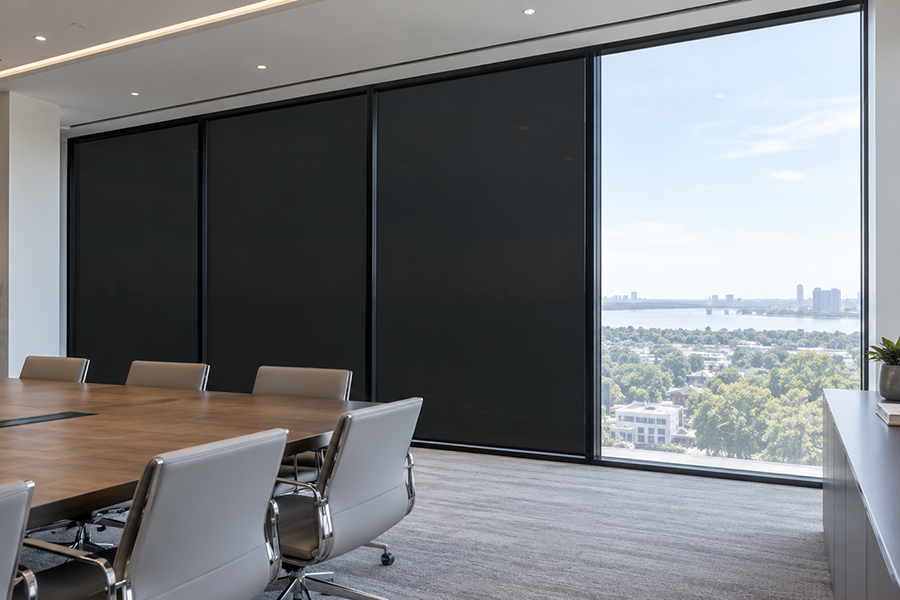
Rethinking Blackout: How Electrostatic Microshading Is Changing Integrated Glass
A motorless approach to blackout, privacy, and solar control within insulating glass.
Electrostatic microshading is a shading technology that uses controlled electrostatic force to deploy an ultra-thin physical shade inside an insulating glass unit. It can transform an open glass panel into full blackout within seconds while also supporting privacy, glare reduction and solar control. Because the shade is lightweight and electrostatically activated, it can operate with low power and without motors, gears or cords.
The innovation begins with a force most people have experienced, even if they have never considered its architectural potential. Static electricity allows lightweight materials to attract, repel or move in response to an electrical charge. Electrostatic shading applies that principle in a precise and controlled way, using it to move a shading element across the visible area of the glass.
This approach changes what can happen inside an insulating glass unit. The cavity between the panes is no longer only part of the window’s thermal construction. It becomes a protected space where a responsive shading system can operate.
How Electrostatic Microshading Works
The “micro” in microshading refers to the extremely thin and lightweight nature of the shading element and its operating technology, not the amount of glass it can cover. When the system is activated, an electric field causes the shade to move into its deployed position. When the shade is opened, the element retracts and restores visibility through the glazing.
The element’s low mass is essential. Because it requires very little force to move, electrostatic attraction can perform the work that would otherwise require a larger mechanical assembly. This allows the shading system to remain compact enough to fit inside double- or triple-glazed insulating glass while still covering the viewing area when deployed.
The shade is physical, not simply an optical effect. In its closed state, it creates an opaque barrier that blocks the view and prevents visible light from passing through the opening. That distinction is what enables the technology to deliver full blackout rather than only darkening or obscuring the glass.
Blackout Becomes Part of the Glass
Blackout is often treated as an interior accessory added after the glass has already been selected. Electrostatic microshading makes it part of the glazing assembly itself.
Sealing the shade between the panes protects it from dust, direct contact and everyday activity within the room. The finished installation retains a smooth interior glass surface without exposed shade material, tracks or operating components. From the room, the transition appears simple: the glass moves from open to fully blocked without a separate window treatment entering the space.
This level of integration is valuable in environments where visual simplicity, cleanliness or limited access to shading components matters. It also allows privacy and light control to be considered earlier in the design process as part of the glass specification rather than as a separate layer added later.
What Full Blackout Makes Possible
The immediate benefit of electrostatic microshading is complete control over visibility and light. An open panel can preserve daylight and views, while a deployed shade can provide full visual privacy and blackout within seconds.
That capability has implications beyond simply making a room dark. Presentation and audiovisual spaces can reduce light that interferes with screens. Conference rooms can gain privacy without permanently closing off the space. Hotel ballrooms and multipurpose rooms can change conditions quickly as their use changes. Healthcare, laboratory and educational environments can create controlled visual conditions while maintaining a clean, integrated surface.
The deployed shade can also limit solar energy entering through the glazing. By blocking incoming sunlight within the insulating glass unit, electrostatic microshading can contribute to glare reduction, indoor comfort and solar heat-gain control. The result is a single integrated system addressing blackout, privacy and solar performance together.
Low Power, More Flexibility
Moving an ultra-lightweight shade requires relatively little energy. This gives electrostatic microshading flexibility in how it is powered and controlled.
Systems can be designed for rechargeable battery operation and activated through a wall switch, wireless remote or connected application. Multiple units can be coordinated, and automated schedules can change the glazing according to the way a space is used. Solar-assisted recharging may also be available, depending on the system and project configuration.
These options allow electrostatic shading to operate as a single controlled opening or as part of a larger group. The appropriate approach depends on the size of the installation, frequency of use, access to power and level of automation required.
Where Microshading Makes Sense
Electrostatic microshading is especially well suited to spaces that need two clearly defined conditions: open and fully blacked out. That makes the intended use of the room an important part of specification.
Project teams should consider the required panel size, control method, power source, frequency of operation and desired solar performance. They should also determine whether units will operate individually or together and how the shading controls will interact with other room or building systems.
These decisions help ensure that the technology is integrated into the project as a functional part of the environment, not simply added as a novel feature.
A New Direction for Integrated Glass
PGS applies electrostatic microshading through Lyto™ Smart Shades, integrating the technology into double- or triple-glazed insulating glass for fast, quiet blackout, privacy and solar control.
Lyto is one architectural expression of a broader idea: lightweight materials and controlled electrical forces can create movement inside glass without a conventional mechanical drive system.
That idea opens a new direction for integrated shading. It allows the protected space between panes to become active, responsive and capable of changing the conditions within a room.
As architectural glass continues to take on more responsibility, electrostatic microshading shows that innovation does not always require making the system more visible or more complex. Sometimes it begins by rethinking what can move, how it moves and what the glass can accomplish as a result.