

Can Architectural Design Actually Reduce Dementia Agitation? Here’s What the Research Shows
Can Architectural Design Actually Reduce Dementia Agitation? Here’s What the Research Shows
Dementia care involves more than medication and staffing. The physical environment can also influence how residents feel, navigate, and respond to their surroundings.
A study led by sociologist and architect John Zeisel examined the relationship between environmental design and behavioral health outcomes in Alzheimer’s special care units. It supports considering environmental approaches alongside medication and care practices when addressing dementia symptoms.
Two challenges recur in this research: disorientation and overstimulation. Both intersect with glazing decisions more directly than many project teams might assume.
Why Personalized Doors Help Residents Find Their Way
A review of environmental interventions for people with Alzheimer’s disease examined how changes to indoor environments can support orientation and social engagement. Signage and personalized visual cues were among the approaches studied.
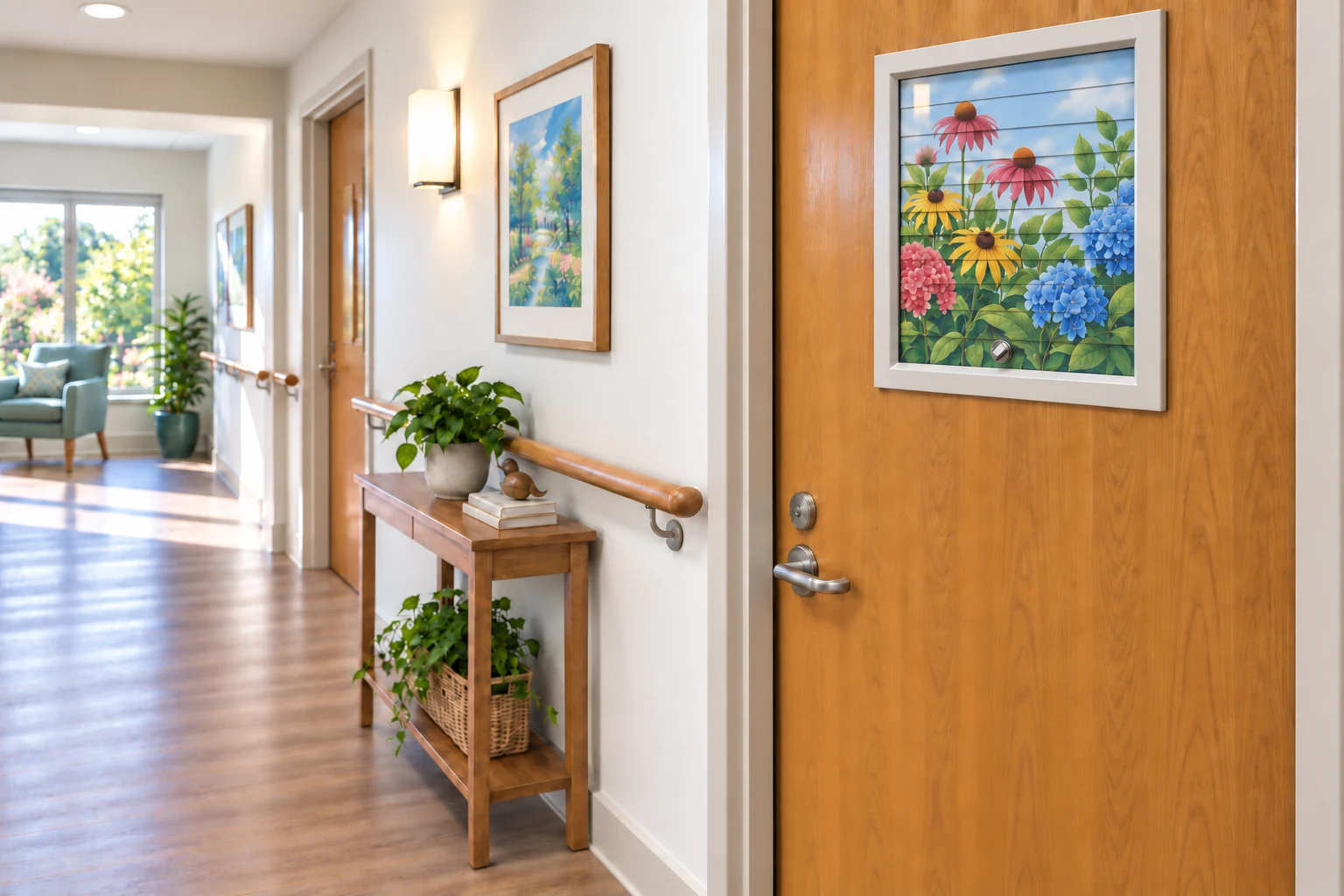
For someone who struggles to recognize their surroundings, a corridor of nearly identical doors can make finding a room difficult. Distinctive imagery and familiar visual cues can give residents another way to identify a destination.
VistaArt, a Vistamatic® mechanical privacy panel option, brings this design principle into the door’s vision panel through custom graphics. Distinctive imagery can help differentiate otherwise similar doors and support a broader wayfinding strategy informed by the research.
The graphic should be considered as part of the complete environment, including the door, surrounding finishes, signage, and the resident’s individual needs.
How to Balance Patient Privacy With Staff Observation
Privacy and personalization are recurring considerations in dementia care design. Residents need personal space, while staff need appropriate opportunities to observe and provide care.
That balance can be difficult to achieve. Full visual enclosure limits observation, while constant visibility can compromise dignity.
Vistamatic® mechanical privacy panels allow staff to change visibility through a door or window without leaving the door open or moving an external curtain. The panel provides a practical way to incorporate adjustable observation into the opening.
For architects and designers, the specification question goes beyond whether a panel provides privacy. It also includes who controls visibility, where the control is located, and how the opening supports the facility’s care practices.
Why a Homelike Environment and Controlled Lighting Matter
A systematic review of residential design research on aging and cognition explores how design features influence the cognitive and emotional responses of older adults.
For memory care projects, this makes the character of the environment an important design consideration. Familiar spaces, recognizable destinations, and manageable visual complexity deserve attention alongside operational requirements.
Lighting is part of that conversation. Daylight can make a space welcoming, but glare and uneven illumination can make it harder to see and interpret the surroundings. Glazing and shading decisions should account for how light changes throughout the day.
BetweenGlassBlinds™ provides adjustable light and privacy control using venetian blinds sealed within the glazing. The slats can be adjusted to manage incoming light, while their enclosed placement protects them from dust and damage.
This gives designers a familiar shading approach that can support the lighting strategy for a resident room or shared space.
Small Design Changes Can Inform the Specification
Much of the environmental research points toward specific interventions that can be considered within an existing facility or a new project: recognizable visual cues, distinguishable doors, controlled glare, and a thoughtful balance between privacy and observation.
Glazing decisions intersect with each of these areas. A vision panel can contribute to a wayfinding strategy. Adjustable visibility can support care routines. Integrated shading can help manage changing daylight.
For architects and designers working on memory care projects, the value of this research is its connection to everyday specification decisions. The question is how each opening can support a clearer, more comfortable environment for the people using it.